Welcome to Xi’an Good Doctor Medical Science and Technology Co., Ltd.website !
Internet Drug Information Service Qualification Certificate: (Shaanxi)-Non-Operating -2023-0143



Animal Experiments
|
Experimental study on the safety of hyperthermic intracavitary chemotherapy |
||
|
|
||
 |
 |
 |
 |
 |
 |
|
This project was funded by Natural Science Foundation of China (NSFC, No: 30973437)
Findings demonstrated
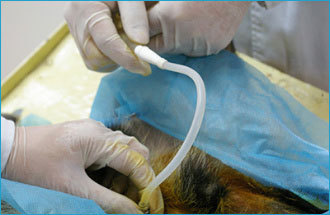
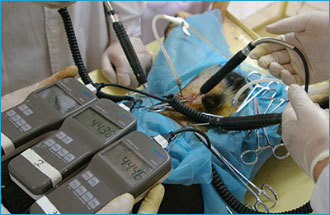
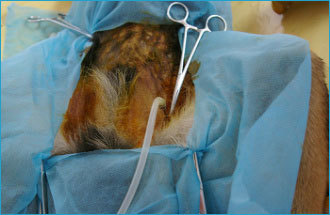
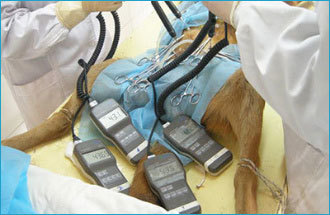
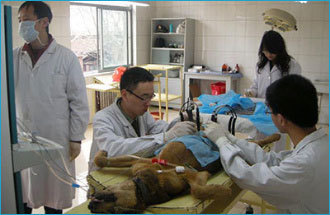
Impact of different HIPEC temperatures on the experimental canine vital signs and abdominal organs was observed. Findings demonstrated that 42℃~42.5℃ were safe during the HIPEC, and that the most effective intraperitoneal temperature for HIPEC is 42.5℃! Equipment used for the experiment: Hyperthermic Intracavitary Chemotherapy Machine, Model GDPR-2100S |
||
|
Animal experiments of comparing the flow rate and temperature with three ways of catheterization for the hyperthermic intraperitoneal chemotherapy |
||
 |
 |
 |
 |
 |
 |
|
Funding source: Natural Science Foundation of China (NSFC, No: 81372608)
Findings demonstrated
Equipment used for the experiment: Hyperthermic Intracavitary Chemotherapy Machine, Model GDPR-2100S Method: 4 thermometers were placed in the lower left, upper left, lower right, and upper right abdominal cavities, respectively, to measure the intraperitoneal temperature at each location.Data were analyzed by ANOVA Results: Flow rate and temperature were measured multiple times from each animal of the 3 three groups; vital signs were stable during HIPEC procedure and all animals had good postoperative recovery Conclusion: Although diameter of the catheters placed via puncture technique was smaller than that of the catheters placed via surgery, both Group B (Internal Medicine mode HIPEC with one In-flow and one Out-flow) and Group C (Internal Medicine mode HIPEC with 2 In-flow and 2 Out-flow) could achieve the flow rate and temperature levels of the Group A (Surgical mode HIPEC with 2 In-flow and 2 Out-flow), with less invasive, better repeatability, and thus, worthy clinical promotion. |
||
|
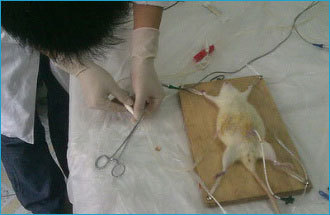
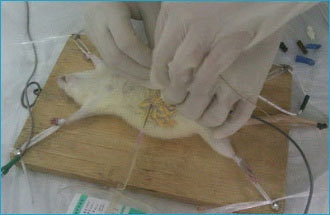
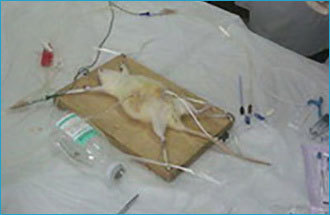
Establishment of a micro-volume hyperthermic perfusion and circulation in the mouse peritoneal cavity via puncture technique |
||
 |
 |
 |
|
Findings demonstrated
A unique technique invented by the Scientists of Good Doctor; micro-volume hyperthermic perfusion and circulation via puncture technique; precisely performed HIPEC in a mouse model |
||
Xi'an Good Doctor Hyperthermic Perfusion Chemotherapy · Animal Experiment · Pioneering Technology · First Public Disclosure
Against the backdrop of the increasingly widespread clinical application of tumor hyperthermic perfusion therapy, Xi’an Good Doctor Medical Science and Technology Co., Ltd. has, for the first time, publicly disclosed the results of three key animal experiments conducted during the R&D phase of its core technology. These experimental studies, spanning more than a decade, have provided robust animal experimental data supporting the safety and precision of intracavitary circulatory hyperthermic chemotherapy. They vividly demonstrate the company’s deep-rooted R&D expertise and solid technological strength in this field.

· China Good Doctor ·
· Good friends of human beings ·
Address: Floor 1-2, Left Building No. 1, Huoju Road, East zone of Xi’an High- tech Development District, Xi’an, China
Copyright Xi'an Good Doctor Medical Technology Co., Ltd.
Internet Drug Information Service Qualification Certificate (Shaanxi)-Non-Operating -2023-0143